Gaggenau Ovens: Expressive, Minimalistic, and the EB 333 Explained
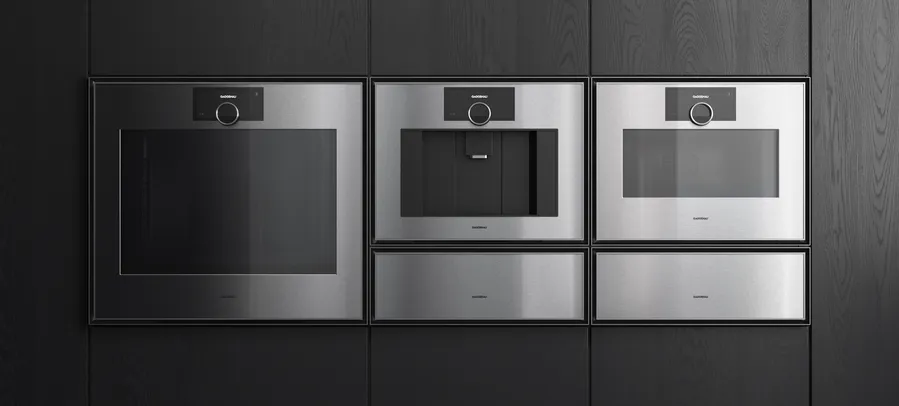
Gaggenau makes three distinct oven series and they are not interchangeable aesthetics over the same product. Each one is built around a fundamentally different idea about what a built-in oven should do to a kitchen. The performance baseline is consistent across all of them: 300°C capability, pyrolytic self-cleaning, professional-grade materials. The choice is about design language and how the appliance relates to the space around it.
Expressive: The Oven as Object
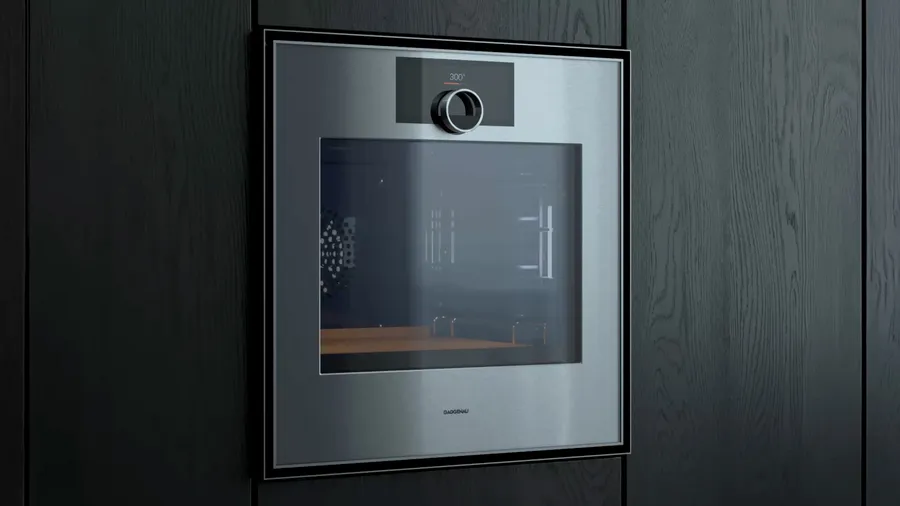
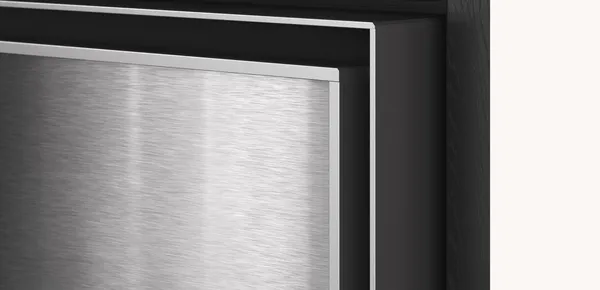
The Expressive series is built around a passepartout — a frame-within-a-frame that sits proud of the surrounding cabinetry. The outer frame borders the joinery; the inner one holds brushed stainless steel behind smoked glass, with an inner chamfer milled to 1.5 mm. It reads as architectural rather than functional, and that is deliberate. A floating stainless steel ring controls up to 19 heating methods. The display illuminates only when you approach via proximity sensor. In 60 cm and 76 cm widths, the Expressive system runs across the full appliance range — ovens, combi-steam, combi-microwave, warming drawers, coffee machine — with the same front face throughout, making it the natural choice for a coherent column or suite configuration in a designed kitchen.
Minimalistic: When the Oven Disappears
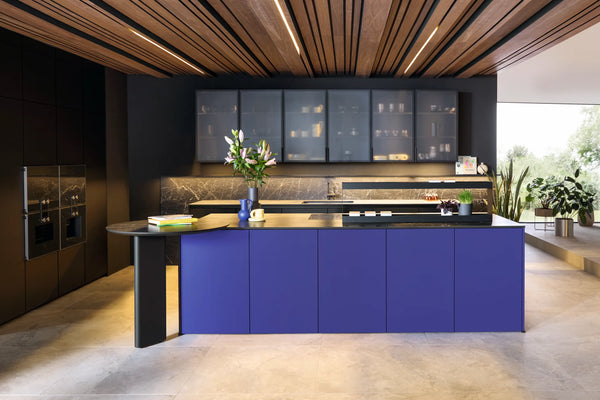
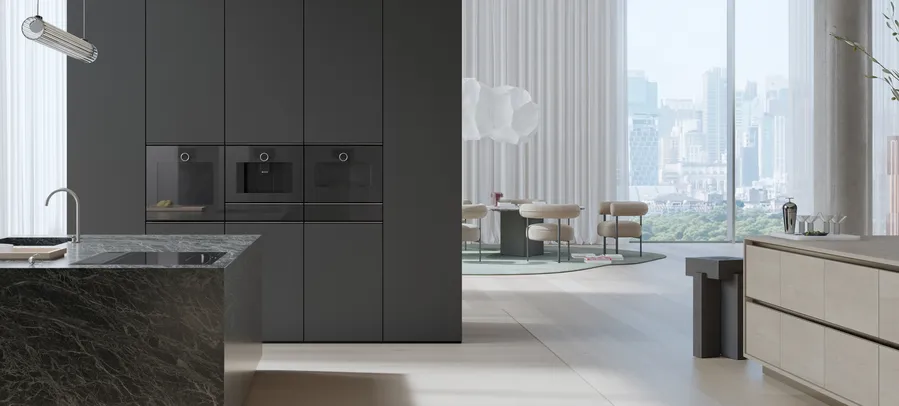
Same performance, opposite approach. The Minimalistic series sits flush with the cabinetry surface, handleless, with a push-to-open door and no frame projecting forward. In Gaggenau Onyx (near-black) or Gaggenau Sterling (warm grey), it blends into dark stone, dark lacquer, or veneer kitchens without competing for attention. For kitchen projects where the joinery and material palette are the composition, this is usually the more coherent choice.
EB 333: A 90cm Icon
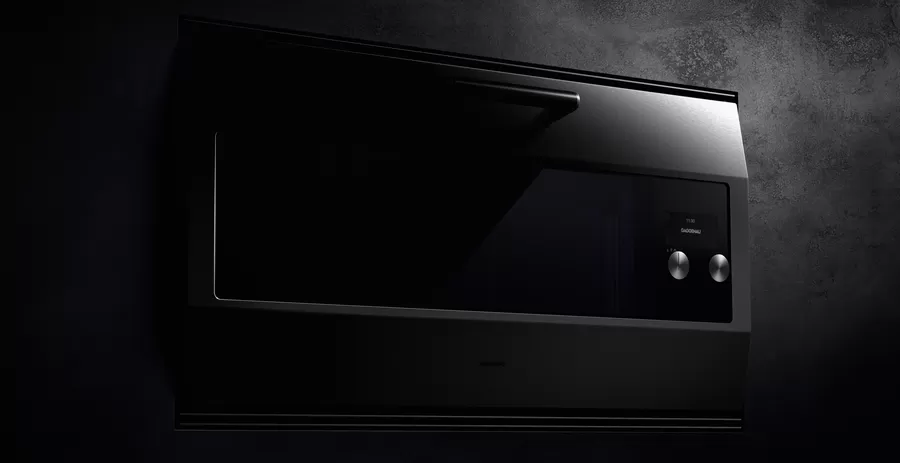
The EB 333 sits in a category of its own. Born in 1986, when Gaggenau's owner wanted a private-use oven with the scale of a professional range cooker, the result was a 90 cm wide, predominantly hand-built appliance that became iconic almost immediately. The current EB 333 is its direct descendant. The door — a single sheet of 3 mm hand-crafted stainless steel, five layers of glass, 20 kg — opens and soft-closes with deceptive ease. Daily production at the Lipsheim facility rarely exceeds single figures. It offers 17 cooking modes, a TFT touch display, rotisserie and core temperature probe accessories. In a villa or large apartment where the oven is meant to anchor the room, nothing else does it the same way.

Series at a Glance
| Expressive | Minimalistic | EB 333 | |
|---|---|---|---|
| Width | 60 / 76 cm | 60 / 76 cm | 90 cm |
| Installation | Proud of surface | Flush to surface | Proud of surface |
| Finish | Steel behind smoked glass | Onyx / Sterling | Stainless steel |
| Heating modes | Up to 19 | Up to 19 | 17 |
| Max temp | 300°C | 300°C | 300°C (pyrolytic 485°C) |
| Best for | Kitchens built around the appliances | Kitchens built around the architecture | Kitchens built around cooking |
The Gaggenau range also covers cooktops, coffee machines, refrigerators, wine cabinets and dishwashers, all sharing the same front face within each series. For full integrated appliance specifications, that coherence matters more than most people account for at the start of a project.